DLI Lab, Yonsei UniversityI'm an Integrated M.S./Ph.D. student at the Data & Language Intelligence Lab, Yonsei University, advised by Prof. Dongha Lee.
My primary research interests lie in structured data reasoning for language models (e.g., tabular and HTML data) and personalized aesthetic assessment (PAA), with an emphasis on fashion-related applications.
") does not match the recommended repository name for your site ("").
", so that your site can be accessed directly at "http://".
However, if the current repository name is intended, you can ignore this message by removing "{% include widgets/debug_repo_name.html %}" in index.html.
",
which does not match the baseurl ("") configured in _config.yml.
baseurl in _config.yml to "".

Donguk Kwon, Dongha Lee# (# corresponding author)
Preprint (arXiv) 2026
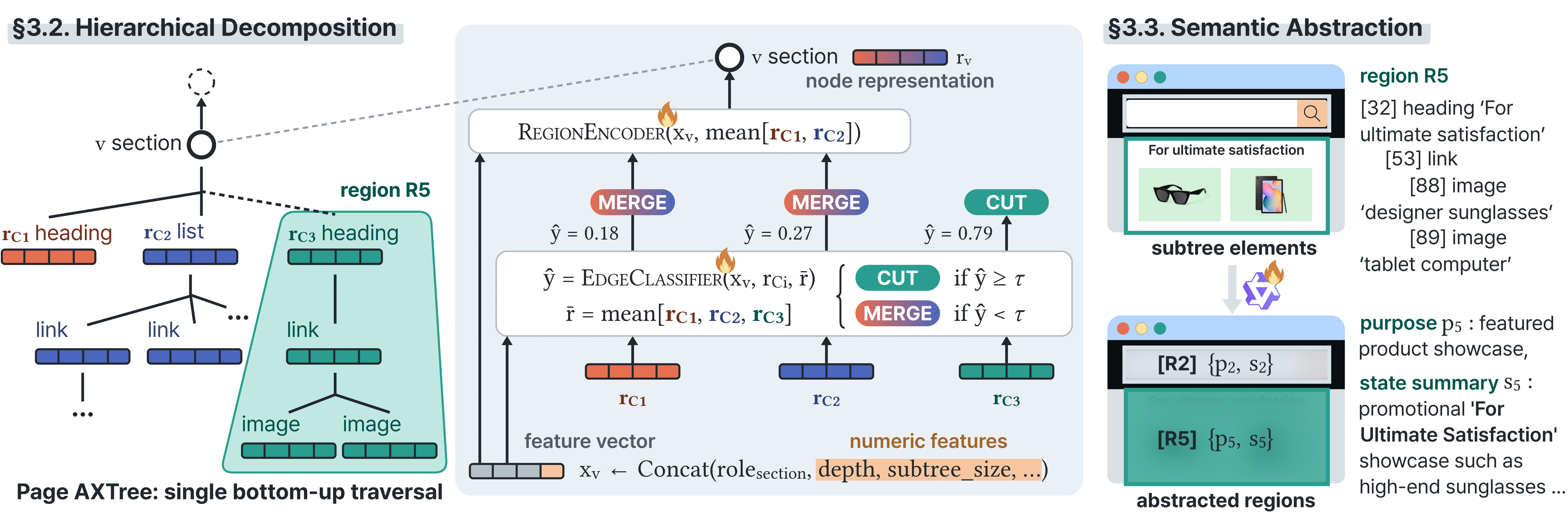
Web agents perceive web pages through an observation space, yet its granularity has remained an underexamined design choice. Existing work treats observation at the same element-level granularity as the action space, leaving the page's functional organization implicit and forcing the agent to infer it from element-level signals at every step. We argue observation should instead operate at the granularity of functional regions, parts of the page that each serve a distinct purpose. We propose Region4Web, a framework that reorganizes the AXTree into functional regions through hierarchical decomposition and semantic abstraction, exposing the page's functional organization as the basis for page state understanding. Moreover, we propose PageDigest, a web-specific inference pipeline that delivers this region-level observation to the actor agent as a compact per-page digest that persists across steps. On the WebArena benchmark, PageDigest substantially reduces observation length while improving overall task success rate across diverse backbone large language models (LLMs) and established agent methods, regardless of backbone capacity. These results show that operating at the granularity of functional regions delivers a more compact and informative basis for the actor agent than element-level processing alone.
Donguk Kwon, Dongha Lee# (# corresponding author)
Preprint (arXiv) 2026
Web agents perceive web pages through an observation space, yet its granularity has remained an underexamined design choice. Existing work treats observation at the same element-level granularity as the action space, leaving the page's functional organization implicit and forcing the agent to infer it from element-level signals at every step. We argue observation should instead operate at the granularity of functional regions, parts of the page that each serve a distinct purpose. We propose Region4Web, a framework that reorganizes the AXTree into functional regions through hierarchical decomposition and semantic abstraction, exposing the page's functional organization as the basis for page state understanding. Moreover, we propose PageDigest, a web-specific inference pipeline that delivers this region-level observation to the actor agent as a compact per-page digest that persists across steps. On the WebArena benchmark, PageDigest substantially reduces observation length while improving overall task success rate across diverse backbone large language models (LLMs) and established agent methods, regardless of backbone capacity. These results show that operating at the granularity of functional regions delivers a more compact and informative basis for the actor agent than element-level processing alone.