2026
Region4Web: Rethinking Observation Space Granularity for Web Agents
Donguk Kwon, Dongha Lee# (# corresponding author)
Preprint (arXiv) 2026
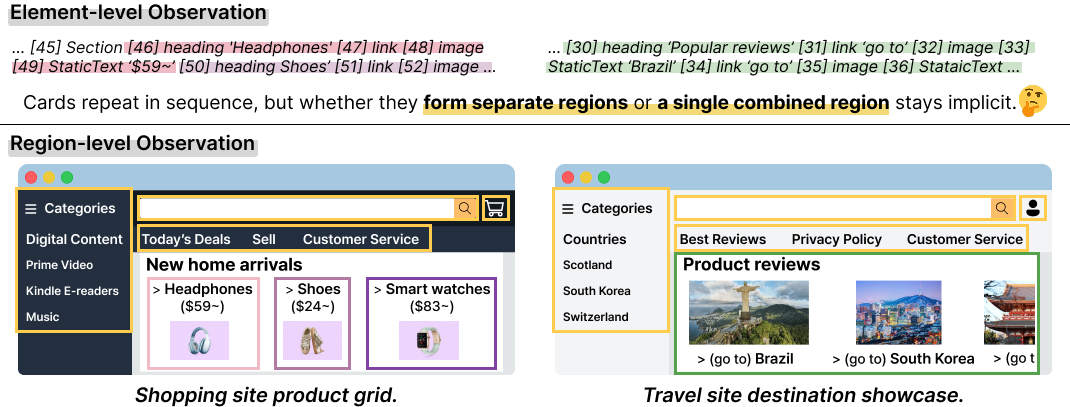
Web agents perceive web pages through an observation space, yet its granularity has remained an underexamined design choice. Existing work treats observation at the same element-level granularity as the action space, leaving the page's functional organization implicit and forcing the agent to infer it from element-level signals at every step. We argue observation should instead operate at the granularity of functional regions, parts of the page that each serve a distinct purpose. We propose Region4Web, a framework that reorganizes the AXTree into functional regions through hierarchical decomposition and semantic abstraction, exposing the page's functional organization as the basis for page state understanding. Moreover, we propose PageDigest, a web-specific inference pipeline that delivers this region-level observation to the actor agent as a compact per-page digest that persists across steps. On the WebArena benchmark, PageDigest substantially reduces observation length while improving overall task success rate across diverse backbone large language models (LLMs) and established agent methods, regardless of backbone capacity. These results show that operating at the granularity of functional regions delivers a more compact and informative basis for the actor agent than element-level processing alone.
Region4Web: Rethinking Observation Space Granularity for Web Agents
Donguk Kwon, Dongha Lee# (# corresponding author)
Preprint (arXiv) 2026
Web agents perceive web pages through an observation space, yet its granularity has remained an underexamined design choice. Existing work treats observation at the same element-level granularity as the action space, leaving the page's functional organization implicit and forcing the agent to infer it from element-level signals at every step. We argue observation should instead operate at the granularity of functional regions, parts of the page that each serve a distinct purpose. We propose Region4Web, a framework that reorganizes the AXTree into functional regions through hierarchical decomposition and semantic abstraction, exposing the page's functional organization as the basis for page state understanding. Moreover, we propose PageDigest, a web-specific inference pipeline that delivers this region-level observation to the actor agent as a compact per-page digest that persists across steps. On the WebArena benchmark, PageDigest substantially reduces observation length while improving overall task success rate across diverse backbone large language models (LLMs) and established agent methods, regardless of backbone capacity. These results show that operating at the granularity of functional regions delivers a more compact and informative basis for the actor agent than element-level processing alone.
2025
MT-RAIG: Novel Benchmark and Evaluation Framework for Retrieval-Augmented Insight Generation over Multiple Tables
Kwangwook Seo*, Donguk Kwon*, Dongha Lee# (* equal contribution, # corresponding author)
Annual Meeting of the Association for Computational Linguistics (ACL) 2025
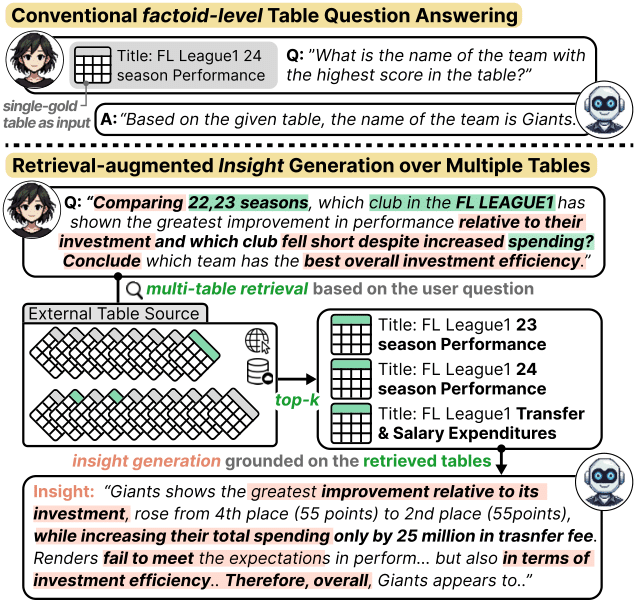
Recent advancements in table-based reasoning have expanded beyond factoid-level QA to address insight-level tasks, where systems should synthesize implicit knowledge in the table to provide explainable analyses. Although effective, existing studies remain confined to scenarios where a single gold table is given alongside the user query, failing to address cases where users seek comprehensive insights from multiple unknown tables. To bridge these gaps, we propose MT-RAIG Bench, design to evaluate systems on Retrieval-Augmented Insight Generation over Mulitple-Tables. Additionally, to tackle the suboptimality of existing automatic evaluation methods in the table domain, we further introduce a fine-grained evaluation framework MT-RAIG Eval, which achieves better alignment with human quality judgments on the generated insights. We conduct extensive experiments and reveal that even frontier LLMs still struggle with complex multi-table reasoning, establishing our MT-RAIG Bench as a challenging testbed for future research.
MT-RAIG: Novel Benchmark and Evaluation Framework for Retrieval-Augmented Insight Generation over Multiple Tables
Kwangwook Seo*, Donguk Kwon*, Dongha Lee# (* equal contribution, # corresponding author)
Annual Meeting of the Association for Computational Linguistics (ACL) 2025
Recent advancements in table-based reasoning have expanded beyond factoid-level QA to address insight-level tasks, where systems should synthesize implicit knowledge in the table to provide explainable analyses. Although effective, existing studies remain confined to scenarios where a single gold table is given alongside the user query, failing to address cases where users seek comprehensive insights from multiple unknown tables. To bridge these gaps, we propose MT-RAIG Bench, design to evaluate systems on Retrieval-Augmented Insight Generation over Mulitple-Tables. Additionally, to tackle the suboptimality of existing automatic evaluation methods in the table domain, we further introduce a fine-grained evaluation framework MT-RAIG Eval, which achieves better alignment with human quality judgments on the generated insights. We conduct extensive experiments and reveal that even frontier LLMs still struggle with complex multi-table reasoning, establishing our MT-RAIG Bench as a challenging testbed for future research.